on turkeys, eggs, and afternoon naps

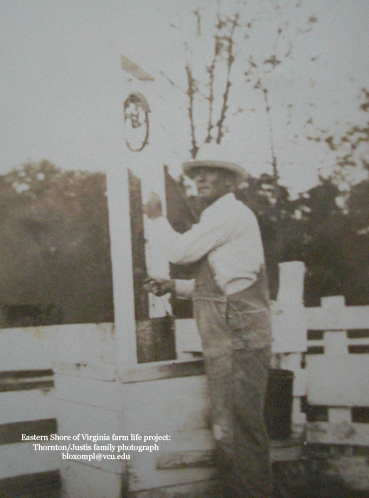
William Justis, circa 1925 (courtesy of Thornton / Justis family)

Daddy raised chickens and he sold eggs. And he said that he didn’t go by the market price on eggs. He said no egg was worth more than five cents, and he wasn’t gonna charge anybody more than five cents an egg. So that was 60 cents a dozen, and he sold chicken eggs for 60 cents a dozen, and he coudn’t supply all of his customers. They all wanted eggs.

He had a little flock of chickens, and he had one that was a pet. That chicken was the cutest thing. He would go out to feed them and, honey, she was at the head of the flock. She ran up to him just like she knew him by name. He loved that old hen.

Mother … didn’t raise turkeys after they moved up by the railroad track, but she raised turkeys down at White’s Neck, and one day … a storm came up in the afternoon, and she had this little flock of turkeys that were kind of back of the house down this roadway that – they were a right little old distance from the house. She had a little coop down there, and a storm came up in the afternoon, and honey, she ran off there kiting it, because she was afraid her little turkeys would get drowned. They were outside.  And she did get wet before she got back to the house, but when I saw her coming – I was standing out on the back porch. The back porch was screened in, and I thought, “Oh, Mother’s going to get wet.”  And, sure enough, she did get wet and when she came up the steps, I opened the door, held the door open for her, and when I hit that door, I got stung – lightning struck – I got stung and I kind of shook a little bit, you know.  But it didn’t bother me. It soon wore off. But I got her in the house, ’cause it was getting stormy – lightning and thunder and stuff going on, and I didn’t want her out in that, but she got her little turkeys in.  She didn’t want them to get wet.  They were the prettiest little things, those little fuzzy things.

Frances (my sister) said that, when I was little, I would bother the egg basket.  Mother would keep the egg basket in the pantry, and the pantry opened on the porch, and I would go in there, and I would bother the eggs.  She told me – I guess it was so – she said they got so that they would put some feathers in the egg basket.  And I was scared of feathers, so I stopped bothering the eggs.

I guess I was four or five years old.  Mother used to put me upstairs in the afternoon to take a nap, and I didn’t like that afternoon nap – oh, that was terrible. And she would put me upstairs, and this bedroom window opened so that I could see the yard, and we had this orchard out back that had peaches and apples and plums and all sorts of good things in it. Mother and Frances would go out in the afternoon and they’d walk around the yard, and they’d go to the orchard, you know, and they’d pick some fruit, and oh, they were just having a ball.  And I thought, oh if I could just get out there with them.  I didn’t understand why she put me up there – I had to have that nap. But she would – I just had to have that nap.  She’d put me up there, and she thought I was asleep, bless her heart, but I was watching every step they made.

But my, it was so different then.  I think children have missed so much.  So many children don’t know – they don’t realize did the egg come first or the chicken, you know?  I don’t guess it makes too much difference, but to me, I cherish it.

from an interview with Ruth Justis Thornton, summer 2009.

Leave a comment

Filed under animals, economy, education, food

very few people, when I was a boy, had tractors

[They] had horses and wagons.  [would] load them in the field and take them out to the broker. Unload them and back to the fields to reload. Horses and mules. Very few people, when I was a boy, had tractors. Very few.  We had one guy by the name of Brooks Horton, he used to go around plowing land for different people, and he had tractors.  Charged so much a acre.

And then eventually we got an old tractor, and that was a lifesaver.

There’s a lot of people, small farmers, had Model A Ford cars and stuff like that – they’d cut them in two and make them shorter and make a tractor out of them.  They pulled, you know, like a tractor.  Because it was short, you could turn in the field.  That’s why they cut them off.  Cut them in two and put them back together – shorter.  It was a mini old Model A cut up during them times.  There’s a lot of people wish they had them now.

They got rid of them once the tractor got a little bit plentiful.  You know, most people sold them for junk.

from an interview with Ernest Finney, summer 2009.

Leave a comment

Filed under animals, progress, technology

“Put the plant in this way …”

Frances Latimer, circa 1978

Frances Latimer, Cobb Station farm, circa 1958 (courtesy of the Latimer family)

[Daddy] hired a person when he could, but there were times when he couldn’t hire anybody and it was my mom and my oldest brother and daddy. There wasn’t much help.

Somebody didn’t come to work one day and Daddy wanted me to work on a transplanter, and I was playing the piano. I was grouchy and sullen. I was a teenager. So I went out. And he said, “okay, sit here. Put the plant in this way, and it’ll go in the ground.” I said, “okay.” I turned it that way.

So, all of the plants were – the leaves were down and the roots were up. And he turned around and he looked and every other plant, alternate plants, the roots were up, ’cause there was somebody else riding it with me, right?

He knew it was me. So he stopped, and he said, “Bea.” He said, “Turn it this way.” He never raised his voice. I’m serious. I never heard him yell. I never heard him say ugly things. So, I said, “okay.” I put them in roots up …

You could tell if you looked [at what you were doing]. I wasn’t looking. Did you want me to look? The roots were up, the leaves were down. And he got off the tractor that time and was serious and he had plants in his hands. He said, “I never beat you with a plant. I never beat you. But I’m going to today. Now you’re not stupid. You can do this. Put them in the right way.” “Yes, Daddy.” I put them in the right way.

Putting them in the right way meant that I knew what I was doing before. I hadn’t really planned to do it, but after I started it, it seemed like fun.

from an interview with Frances Latimer, summer 2009

Leave a comment

Filed under education, food, technology

“I guess you know how to drive, don’t you?”

I was driving a Model T truck in the field. They were loading ’em up, you know, and going along the rows where the barrels were, when I was ten years old. I was ten in May, and in June, July, we were digging those potatoes. I didn’t drive it out on the road then, but I drove it. I was driving before I was old enough, old enough to have a license.

We only had one state trooper in Accomack County, and that was Harry Parker. He lived at Accomac, but his wife and my grandfather were first cousins. That’s right. And he told Papa one day, said “that boy is driving, and I know it. And I know he’s got no license. Now I’m not gonna pull him because I know he’s got no license. But if he gets in trouble, I got to carry the law.”

So, one day, I decided to go down there and get my license. Well, I wasn’t eligible to go down there, see. I went by myself, and I went in the office at the Accomac courthouse. That little book, I knew that. He didn’t even have to ask me, I could give him all the answers. And he went through all that and he said, “well I guess now we’ll have to see how you do driving. Drive around the block and see how you park between the sticks.”

He had never smiled a bit – he made a good officer. He could scare people just with that look, you know. The only time he smiled, when he got ready to get in the car, he was on the passenger side. He said, “I guess you know how to drive, don’t you?” And I said, “Yes sir, I think so.” I couldn’t help [but] laugh – he was laughing too. ‘Cause he knew I’d been driving, you know, a long time. I rode around the block and parked back. I usually parked pretty good in a parking place. And I got my license. And guess how much it cost then? I think that was about ’36 or ’35. Fifty cents.

A lot of people were driving that didn’t have them. But that was wrong for me to ride down to Accomac to the courthouse and park right in front of there with no more license than – well my dog’s out here somewhere – than that dog has.

from an interview with Norman Mason, summer 2009

Leave a comment

Filed under economy, transportation

on slop buckets and homemade scrapple

Richard: My daddy never did have a sow. But there would always be one or two or three people in the neighborhood … one would have three or four sows, and another would have one or two boars. So, you’d take the sow to the boar and get her fixed up and sell the pigs to somebody who didn’t have a sow or a boar. It was always somebody who had pigs for sale. You killed hogs always in December.

You had to wait for cool weather, see. There was no such thing as ice box, as refrigerators back then. You’d depend on salt. You killed hogs after it turned cold, from the 5th to the 20th of December. And then, as soon as you got straight, January or February, that’s when you got your pigs for the next year.

You had them in the pen, and you started feeding them. In the wintertime, you could turn them out and let them fend for themselves on the rye and stuff, but after you planted your crops, of course, then you had to put them up. Feed them corn and slops. Everybody had a slop bucket in the house.

Nora Lee: Whatever slops you had, even your dishwater. Dishwater – you would use it.

Richard: Put it in the slop bucket to feed the hogs. Everybody had a smokehouse, that’s true. You salted everything, see, and you hung it up in the smokehouse.

Nora Lee: Your sausage, also.

Richard: And we did bacon. It was put in the smokehouse. Of course, it’s salty as brine, you know, has to be to keep.

Nora Lee: Lard. We used to trap lard.

Richard: Yeah.

Nora Lee: Chittlins. I never did eat chittlins.

Richard: No, the blacks always ate the chittlins. They always got the guts.

Nora Lee: We used to make scrapple. It’s the liver and kidneys and …

Richard: It’s some of the – golly they’re awful – heart, liver, kidneys …

Nora Lee: Homemade scrapple is much better than what you can buy today.

Richard: That was a delicacy, and you had that right after you killed hogs. See, you didn’t have any way to keep anything unless you salted it.

Nora Lee: Tenderloin we used to can. My mother used to can that. Oh, it was so good.

from an interview with Richard and Nora Lee Parks, summer 2009

1 Comment

Filed under animals, food

when a hundred dollars cash money at Christmas would last until Spring

Richard: I heard my father say when he was a boy – he was born in 1900 – when he was a boy, his daddy said if he had a hundred dollars cash money at Christmastime, he was alright until Spring – on a hundred dollars. Isn’t that crazy? Only thing they had to buy was kerosene …

Nora Lee: … flour, sugar …

Richard: …flour, sugar, and doctor bill once in a while, which was probably $5. I mean, when you’ve lived as long as we have … it’s just mind-boggling to see how far $100 goes now. I mean it’s weekly [now] …

We lived on a farm. We got our mail from Pastoria. … Dad let us go to the store most nights. The men always talked around the old country stove, and I’m talking during the ’30’s now, during the Depression, and us boys played Dead Mule and Lost Track and Hide and Seek and all the other games boys and girls play. So, it was a good life.

We didn’t have any money. Nobody had money.

Nora Lee: Nobody, so everybody was poor.

Richard: The store was two miles through the woods. I made many a trip out there with a dozen or two dozen eggs or a piece of fat meat to get mamma’s groceries, and if it was 15 cents leftover, you got what you’d call a due bill. The store master, the storekeeper, gave you this little piece of paper that – owed you 15 cents for a side of meat or a dozen eggs.

That was the hub, yeah. That’s how you – well, you bought everything you needed. You bartered for most of it with eggs or a side of fat meat.

On Saturday night [when we went into Parksley] … we got a quarter. Fifteen cents for the movie. And ten cents for an ice cream cone. Ice cream cone was about a nickel or a Coke or whatever, but it was ten cents to throw away. That was what we got. We got 25 cents Saturday night.

Nora Lee: That was the highlight of your week.

Richard: For working all week. And my job at home … As soon as the boys got big enough to do anything, the boys took over. My brother milked the cow. I never did have to milk the cow, but my job was tend to the woodpile. Keep the wood split and fill the woodbox up when I came home from school. So, that’s kind of quaint, isn’t it?

Of course, you’re talking about ten cents for a gallon of kerosene or fifteen cents or something like that. I don’t know how much a pack of cigarettes was then, but everybody smoked – well, most people rolled their own.

Nora Lee: Cheaper.

Richard: Gosh, a bag of Bull Durham was five or ten cents, and that was a right good size – would make a lot of cigarettes. … It has a string on it that you pulled the string and that tightened it up. When you pulled it open, you could dump it out in your cigarette. And some people, boy you talk about – they could roll a cigarette …

We entertained ourselves if Daddy let us have [time off]. Saturday afternoon most of the time was ours, and we boys – we played in the creek and swam and, like boys will do, did all kinds of throwing mud and mud baths and such as that. There really wasn’t anything real exciting that went on ’til Saturday night when we went to Parksley.

from an interview with Richard and Nora Lee Parks, summer 2009

Leave a comment

Filed under economy, entertainment, food

… and that’s the way she taught us.

Rhoda Dalby Young, 1935 (courtesy of the Dalby/Young family)

They had a two-room schoolhouse [in Westover, Maryland]. In fact, it had been a big two-room – a double one – but we had our school in one of [them]. The other was used for library books and special supplies. Miss Mary Wetsel – she was a Catholic – and she taught five grades.

I [started] the second grade [in Lower Northampton County] and had Ms. Hurt. … and that’s where I had my first little boyfriend. Billy … he gave me a little cage with a key on it that had a little bird in it, and you’d turn that and the little bird would sing. … But in the second grade Billy called Ms. Hurt one day, and he had a bracelet and it had “Rhoda Dalby” on it. His mother had bought it for him. He was asking her to fasten it for him, and she was all smiles there doing that. But anyway, he asked me if I wanted to wear it, and I said, “No, I don’t want to wear it.”

But anyway, going back to the one-room schoolhouse, there would be, as you go in the front, we had a bucket of water on the table in the back with a cup, and we had two little johns outside. That way was the boys, and that way was the girls, and I was in the second grade, so I was not in the first aisle as you came in.  That was the first grade.  The second was the second grade. And the last – there were not that many in the second grade, so the row was finished out with the third graders. 

And then there was a big pot-belly stove filled with coal, and they had a zinc thing around it to keep it from – the children from falling against it.  So, the other side, you went to the fourth on the far wall and then the fifth against that stove. 

She was fabulous. She was an old maid – Miss Mary – but she was sweet to us. There was a big blackboard in the back of the room and a long, like a church bench in front of it, so she would take grade one and maybe with grade one, she’d have a thing up there with birds. “How many birds? Did you see a Robin?” “One” or whatever, and that’s the way she taught us.  

And then, of course, we would progress and we three little girls would go to visit her in the summertime.  I remember, one year, she went across the country, and so we went and visited with her and sat and listened to her story about going across the country.  We were like that.  

…  Mother sewed, so we had little dresses, not many, but she made everything we wore.  We would go and visit up and down in Westover … everybody [would say] “those little Dalby girls” but we enjoyed life there.

from an interview with Rhoda Dalby Young, summer 2009

Leave a comment

Filed under clothing, education, entertainment

“I’m trying to send Ralph down the well …”

 We put milk down the well in a bucket. We didn’t have pumps – not electric ones anyway.  … see, it would stay cool in that water, down in the well.  That water was  always cool.  

ryoung

Ralph Young with his sister, circa 1934 (courtesy of the Young family)

One day, for some reason, a jar of milk broke in that well.  I would guess I was about six or seven years old, and they bailed that water out as fast as they could as it sprang in there to get that old milky water out.  When it got down there, you could see the glass down there from that jug. 

“Well, how about you go down there in this well”  (this is my father) “and get that glass.”  

I didn’t want to do it, and I started crying. They had me in that bucket – getting ready to lower me down, and I was crying still.  

You ever hear of L. B. Justice Used Car dealer?  He was from Bloxom.  He lived next to us, and he was  – when I started school, he was on the bus, but he was finishing school.  And he came over, he lived next door.  “What’s going on, Harvey?”

Daddy said, “well, I’m trying to send Ralph down the well to get this glass – broke a jar of milk down there.” 

And, of course, I was crying and he came up and he was on Daddy’s side. He said, “Ralph, you go on down … there’s nothing to it, you just go down and pick that glass up and come out.” 

Well, anyway, they started lowering me down in there.  That well … you got down in there deeper – it was a long, deep well, it felt like that wall was coming in on you, and when I got to the bottom, the water ‘s springing around your feet – it was scary.  And I finally got the glass, the big glass at least, in the bucket and they pulled me up.  I’ll never forget that day. 

That’s how we kept our milk cool down in the well.  Didn’t have any ice.  And no refrigerators.

from an interview with Ralph Young, summer 2009  

2 Comments

Filed under food, technology

I’m gonna give it a try

And this is what Dad said.  Dad was 17 or 18 years old.  I think he had ideas of wanting to go places and do things. He told his Dad one day “Pop, I’m not going to stay on the farm.”  

[His pop] said, “Tom, you might as well stay on the farm.  You’re gonna leave the farm and … you’re going to become hungry.” 

He said, “I might, but I’m gonna give it a try.”

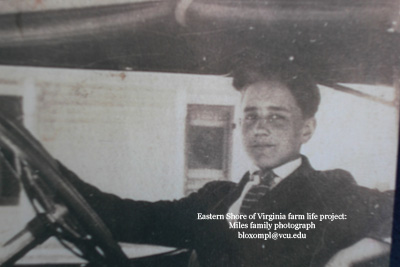
Tom Miles in a Model T Ford, circa 1918  courtesy of the Miles family

Tom Miles in a Model T Ford, circa 1918 (courtesy of the Miles family)

He started working for A.W. Short & Supply Co. – by the highway … nearby the railroad.  He went to work for them.  And he was 17, and that man Messick had a daughter … well, they saw the beauty in each other, and they were married.  

Dad had some good things that happened and some not-so-good things that happened to him financially.  … The depression.  The depression hit.  They had built a store by that time and done well with it and made good money. He and Hank Lewis.

… this is the important thing.  My father didn’t go into bankruptcy but Hank Lewis didn’t either, but he paid his off in cash, what he owed, and Dad couldn’t, so he borrowed money from Mae Mason, it was.  And he worked that out $5, $15 at a time until it was paid off by working in Washington, D.C., at Hecht & Company.

He knew the old man – Hecht of Hecht & Company – big man, you know? …

… we had a rough time of it … Twenty dollars a week he made up there.  He tried to see to the three of us – my mother, my sister, and me – all of it practically … That was during the depression … yeah, it was a bad time, a bad time.

from an interview with Bill Miles, winter/spring 2009

Leave a comment

Filed under economy, food

Hog killings were big days like Christmas

I was born in 1932 …. and I can remember my mother saying that we fared a lot better in the country than the people did in the city during the depression years because we had our own food. 

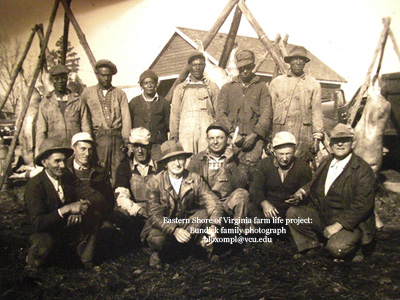
Bundick family hog killing, Assawoman, VA, circa 1938 (courtesy of Thomas family)

Bundick family hog killing, circa 1938 (courtesy of the Thomas family)

 We had our hogs and we had hog killings … and they were big days, you know, like Christmas or something, when the family would get together and the cousins and the aunts and the uncles to help one another.  Everybody would come and slaughter the hogs (which probably sounds gross to our generation or to your generation) but that’s where we got our meat – our hams and our scrapple and our sausages and we made our own lard.  So, we had the necessities of life right on our farm.  

We grew our chickens.  We had our own eggs.  I remember going to the store with my mother and she would carry eggs to exchange for groceries.  … We really didn’t need many groceries in those days.  Flour, sugar, things like that.  I remember her carrying a large quart can to have molasses pumped out of this big barrel into the quart jar, and we had a cow, and so we had our milk, and Mother made her own butter.  We had our own vegetables we grew … of course, we had a garden, but we had a farm and we grew potatoes. 

We had three black men who worked for us regularly – always.  And my mother, she cooked for them, and they ate two meals a day … in our kitchen.  She made biscuits every morning.  And, of course, pancakes and all that … fat meat she fried that’s no longer good for us now.  

We had a lot of meat … We had hams in the smokehouse, so when you got ready for supper, if you were going to have ham, you went down to the smokehouse. You had a big butcher knife that you sliced a couple slices of this ham.  And then you always had potatoes.  … We had our own eggs; we had chickens and ducks and so we lived pretty well on the hog, as they say.  

from an interview with Patsy Bundick Thomas, winter/spring 2009

1 Comment

Filed under animals, economy, food